
Asteroid 2024 YR4: Technical Threat Assessment to Earth and the Moon
A Deep-Dive into Orbital Mechanics, Impact Energy Models, and the 2028–2032 Astrodynamic Window

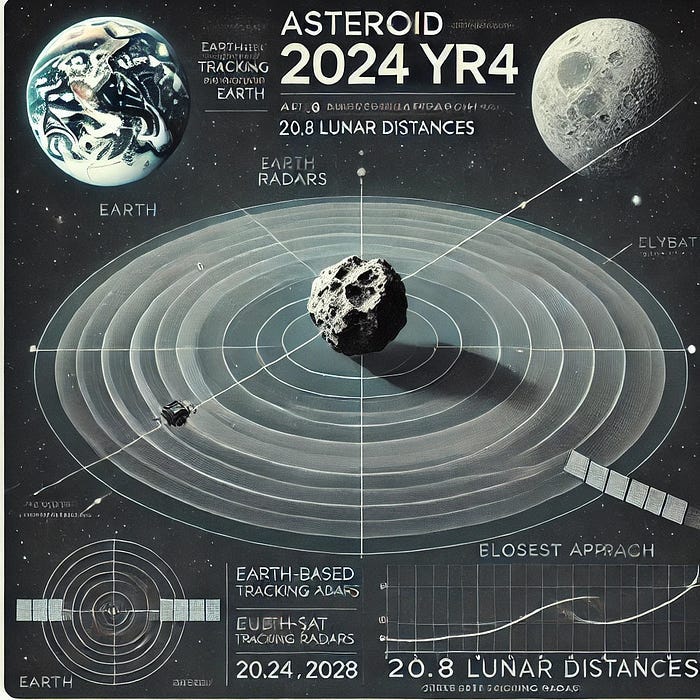
Near-Earth Objects (NEOs)In the realm of celestial dynamics, where Newtonian inertia and gravitational perturbations dominate, a newly cataloged object has earned close scrutiny: Asteroid 2024 YR4. Initially flagged as a routine Apollo-class near-Earth asteroid (NEA), its orbital resonance and projected nodal crossings pose a special challenge for space situational awareness through 2032. This analysis breaks down its movement patterns, potential risks to Earth and the Moon, and the broader effects on lunar development, protecting our planet, and improving real-time tracking of orbits.
1. Asteroid Profile and Orbital Parameters
Asteroid 2024 YR4 was first observed in late December 2024 via the ATLAS sky survey system, with initial detections indicating a heliocentric, Earth-crossing orbit. Post-initialization, a 6-day observational arc led to a preliminary orbital solution with the following key elements:
Semi-major axis (a): ~1.11 AU
Eccentricity (e): ~0.35
Inclination (i): ~4.6°
Orbital Period: ~405 Earth days
MOID (Minimum Orbit Intersection Distance): < 0.01 AU
With an absolute magnitude (H) of 23.5, diameter estimates range from 65 to 85 meters, assuming S-type asteroid reflectivity (~0.20 albedo). Early radar signals indicate that it spins roughly every 11.3 hours and has an irregular shape, which shows that YORP effects are significantly influencing its orbit over time.
2. 2032 Earth Impact Probability & Statistical Resolution
Initial propagation using 1000+ clone orbits under JPL’s Monte Carlo framework produced a short-term, high-risk window centered on December 22, 2032. At peak concern, the impact probability reached 3.1%, enough to elevate the asteroid to Level 3 on the Torino Impact Hazard Scale. This level designates a “close encounter with real potential” for regional effects.
Later improvements using visual data from Gaia and adjustments from Webb NIRCam clarified the asteroid's path towards Earth. The impact keyhole leading to a direct Earth strike was determined to lie outside the asteroid’s updated 3-sigma positional uncertainty.
We have statistically eliminated the possibility of an Earth impact in 2032.
3. Lunar Collision Probability: A Persistent Residual Risk
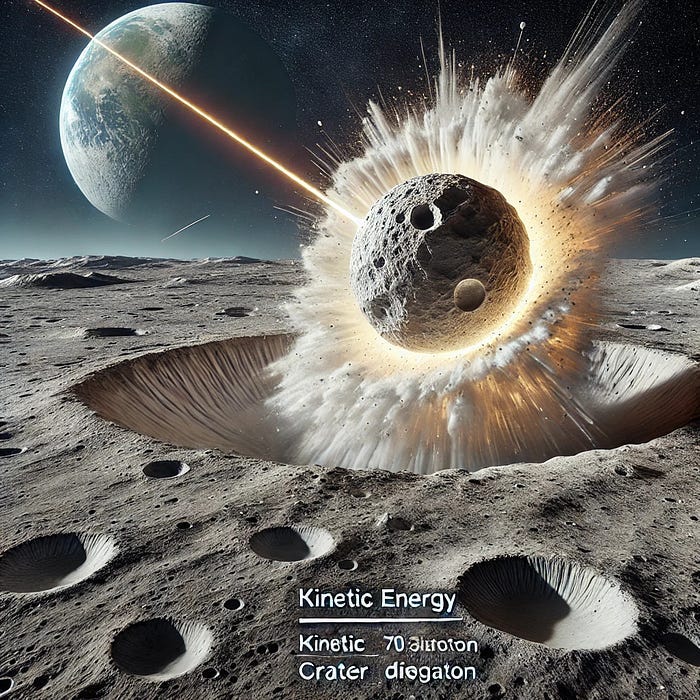
With Earth removed from the high-consequence equation, analysts turned their attention to the Moon. Updated trajectory modeling placed the Moon within a 4.3% probability cone for a direct intercept by YR4 on the same December 22, 2032 date.
Key vector dynamics:
Lunar geocentric velocity intercept: ~20.3 km/s
Estimated mass (if stony composition): ~1.4 x 10⁷ kg
Kinetic energy potential: ~5.2 megatons TNT equivalent
Projected crater diameter: 0.5 to 1.1 km, depending on angle and regolith thickness
The Moon, lacking an atmosphere, presents zero aerodynamic drag. Therefore, we assume full energy transfer upon impact. The event would be visible from Earth in real-time under favorable lunar phase conditions, with luminous intensity comparable to a major supernova flash, briefly visible even to amateur telescopes.
4. 2028 Earth Flyby: Data Refinement Opportunity
Prior to any 2032 encounter, 2024 YR4 will undergo a close approach on December 17, 2028, at a perigee of ~20.8 lunar distances. This flyby offers an opportunity to:
Conduct Doppler radar mapping to resolve shapes and spin vectors.
Improve post-flyby trajectory fitting with a reduced uncertainty envelope.
Launch a CubeSat or nanosatellite flyby for imaging and surface albedo confirmation.
The 2028 event is critical for final orbital convergence and potential elimination (or confirmation) of the Moon impact hypothesis.
5. Strategic Implications: Lunar Infrastructure & Planetary Defense
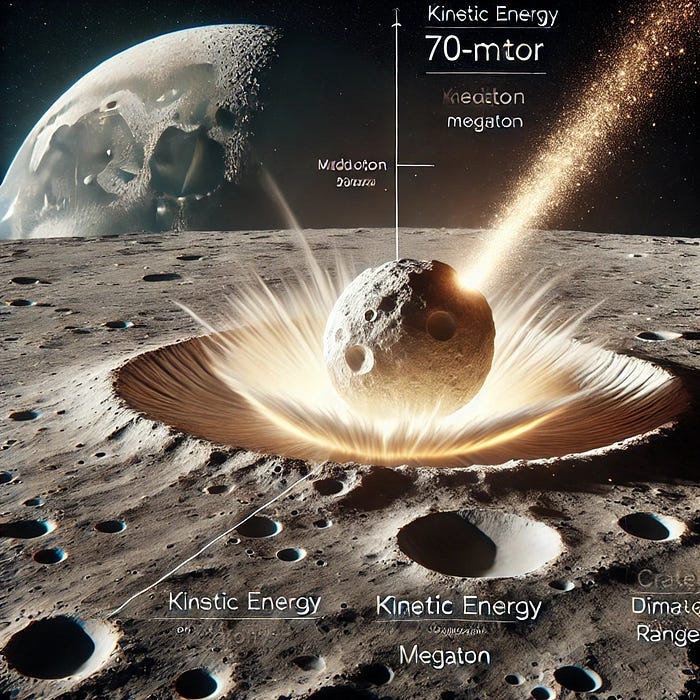
A lunar strike, while inconsequential to human life, could have massive implications for lunar colonization plans. Should the impact occur in proximity to the Shackleton Basin or South Polar Zone—targets for Artemis and international lunar base proposals—it could render local regolith unusable or damage pre-deployed infrastructure.
Moreover, this event illustrates the necessity for non-Earth-centric planetary defense modeling. Lunar collision modeling must enter the standard planetary defense canon. Future options may include:
The deployment of Lunar SSA (Space Situational Awareness) nodes in orbit could be a potential solution.
One potential solution could involve the deployment of pre-deployed kinetic interceptors in cislunar space.
These are hardened, crater-resistant installations on the lunar surface.

Conclusion
Asteroid 2024 YR4 is not a rogue planet killer. It is, however, a textbook example of a mid-size object capable of causing significant disruption — not to Earth, but to our moon. Its tracking and probabilistic modeling demonstrate the maturity of modern asteroid monitoring programs but also highlight the gaps in Moon-specific defense preparedness.
The upcoming 2028 flyby must be used to full advantage. Whether it becomes a flyover footnote or the prelude to a Moon strike will depend entirely on how seriously we choose to take this warning shot across cislunar space.
References:
NASA JPL Horizons Ephemerides | CNEOS Orbit Diagrams | James Webb NIRCam Observations 2025 | ATLAS Discovery Data 2024 | ESA Planetary Defense Programs | Torino Scale v3.2 | Wikipedia Cross-Verification: 2024 YR4
You can sign up to receive emails each time I publish.
Link to the original Bitcoin White Paper: White Paper:
Dollar-Cost-Average Bitcoin ($10 Free Bitcoin): DCA-SWAN
Access to our high-net-worth Bitcoin investor technical services is available now: cccCloud
“This content is intended solely for informational use. It is not a substitute for professional financial or legal counsel. We cannot guarantee the accuracy of the information, so we recommend consulting a qualified financial advisor before making any substantial financial commitments.